


Types of Automatic Transmissions Explained: CVT, Dual-Clutch, and More
If you were to ask most drivers what happens when they put the transmission in drive, you might get a shrug and a smile. It just works, right? That is the whole point of an automatic transmission: It fades into the background so you can focus on the road instead of the mechanics underneath you. But here at Frank Boucher Volkswagen of Racine, we spend a lot of time talking with customers about exactly this topic because the truth is, not every automatic transmission behaves the same way. Knowing the different types of automatic transmission out there is important when car shopping. Here’s what you need to know about the different types of automatic transmissions.
What Exactly Is an Automatic Transmission?
An automatic transmission is a type of transmission that shifts gears automatically so that the driver never has to think about a clutch pedal again. Automatic transmissions also handle the decision of which ratio to use to deliver optimal power from the engine to the wheels in a smooth and efficient manner. That sounds simple enough, but automakers have developed several different ways to accomplish this over the years. Whether you are trying to learn about a VW Transmission for the first time or just want a quick refresher before you get behind the wheel, it helps to know the main players.
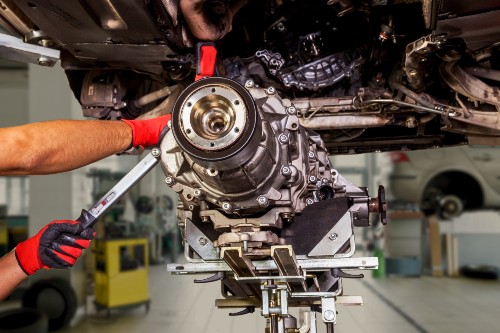
Engineering Innovation Under the Hood
Modern gearboxes have evolved significantly from old-school mechanical systems. Understanding your vehicle’s layout helps ensure proper maintenance and a more satisfying driving experience.
The Classic Torque Converter Automatic
This is what most people picture when they hear “automatic.” The transmission shifts using a torque converter, sending the power through a fluid coupling, which allows for almost imperceptible shifts between gears. It has been around a long time, not only because it works, but because, with regular maintenance, it holds up well over time. If you want a transmission that just fades into the background while you drive, this style has always been an excellent choice.
DSG, Volkswagen’s Signature Dual-Clutch System
If there is one gearbox that can be credited to Volkswagen, it is definitely the DSG, or Direct Shift Gearbox. It is not a single-clutch system but a dual-clutch system in which each clutch separately handles odd-numbered and even-numbered gears, respectively, working together. Because the next gear is preselected, changes are virtually instantaneous and occur with minimal loss of power. Drivers report that the dual-clutch transmission gives a sportier, more direct feel than a conventional automatic. This is why the DSG is used both on the performance versions of the Golf, including the Golf GTI and Golf R, and on many of the standard models in the current lineup.
Continuously Variable Transmissions: A Brief Overview
A CVT is very different because it does not provide a set number of gear ratios. Instead, it uses a belt and pulley system that allows for an almost infinitely variable set of gear ratios. The result is a drive where there are no perceptible shift points at all, just steady, continuous acceleration. A common question we often hear is, does VW use CTV technology? We can honestly say that Volkswagen has used CVTs in some markets and vehicles. Fuel economy is an important reason some people choose CVTs, but the technology has never been as central to Volkswagen’s brand identity as DSG.
Tiptronic Mode for Drivers Who Want a Little Control
Many modern Volkswagen automatic transmissions are equipped with something called Tiptronic. Note that it is not a separate transmission but a feature of a standard or DSG automatic that allows the driver to change gears by moving the transmission shifter or using the paddles. It is not a full manual mode, and no clutch pedal is needed. It gives you the convenience of an automatic for day-to-day driving while allowing you to take a more hands-on approach when you want it, such as on a winding road or while towing.
The Shift Toward Electric Powertrains
Here is where things have changed quite a bit recently. With Volkswagen rolling out more electric vehicles like the ID.4, fewer cars on our lot have a traditional multi-speed transmission at all. Electric motors deliver power consistently, so there is generally no need to build a multi-speed gearbox, with most electric vehicles using a single-speed direct-drive system. The single-speed arrangement is a simpler mechanical design than a conventional transmission. Driving an EV is a different experience from driving a conventional vehicle and requires an informed discussion.
Why This Actually Matters When You Shop
All of these Volkswagen transmission differences lead to real-world changes in how the car accelerates, how it sounds, how it feels during day-to-day driving, and how much fuel it will consume over its lifetime. When you visit Frank Boucher Volkswagen of Racine, we can help you learn about the different performance characteristics of each model. Visit us today to find the perfect car for you.
Visit Frank Boucher Volkswagen of Racine
Ready to test drive your next VW and experience these transmissions firsthand? Stop by our showroom today!
0 comment(s) so far on Types of Automatic Transmissions Explained: CVT, Dual-Clutch, and More